Gajar Ka Halwa — literally "carrot pudding" — is the undisputed king of Indian winter desserts. From November to February, across every North Indian household, wedding buffet, festival table, and sweet shop, Gajar Ka Halwa is the dessert that says "it's cold outside and everything is going to be warm and wonderful." It's the Indian equivalent of Christmas pudding — seasonal, indulgent, deeply nostalgic, and impossible to eat just one bowl of. "Gajar ka halwa recipe" is the most searched Indian dessert term during the colder months, spiking every year from October to January.
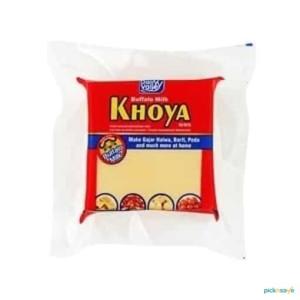
The recipe is ancient and the technique is honest: grate carrots, cook them slowly in milk until the milk evaporates and the carrots caramelise, then enrich with ghee, sugar, and cardamom. There are no shortcuts to the slow-cooking step — the 30+ minutes of gentle simmering transforms raw carrot into a deep, concentrated, fudge-like sweetness that no amount of added sugar can replicate. The carrots themselves become the dessert. At Pick N Save, we stock Indian red carrots (Indian Carrot 400g) — these are shorter, darker red, and significantly sweeter than regular orange carrots, producing a deeper colour and more intense halwa. We also stock Dairy Valley Khoya 300g for the enriched version, KTC Butter Ghee for the authentic flavour, and every nut for garnishing. We've been the winter halwa headquarters for Harrow since 1999 — our carrot and khoya sales spike every December.
Peel and grate 500g of carrots on the coarse side of a box grater. Indian red carrots (Indian Carrot 400g — buy 2 packs) are the traditional choice and produce the richest, deepest-coloured halwa. If unavailable, regular orange carrots (Carrots 500g) work perfectly well — the colour will be bright orange instead of deep red, and the flavour will be slightly less sweet, but the technique is identical.
Grating technique matters: Use the coarse holes, not the fine holes. Coarsely grated carrot gives the halwa its characteristic texture — visible shreds of caramelised carrot suspended in a fudgy base. Finely grated carrot produces a smoother, paste-like halwa that's less interesting texturally. Don't use a food processor — it chops rather than shreds and produces uneven, chunky pieces.
In a large, wide, heavy-bottomed pan (the wider the pan, the faster the milk evaporates — a wide pan saves 10 minutes), add the grated carrots and 750ml of full-fat milk (Freshways Whole Milk 2L). Full-fat is essential — the milk fat enriches the halwa and contributes to its fudgy texture. Semi-skimmed or skimmed milk produces a thin, watery halwa with none of the richness.
Bring to a boil over high heat, then immediately reduce to a medium simmer. Stir every 3–4 minutes to prevent the milk from catching on the bottom. Cook for 20–25 minutes — the milk will gradually reduce, thicken, and eventually be almost completely absorbed by the carrots. You'll see the colour deepen as the milk solids caramelise with the natural sugars in the carrot. The mixture is ready when: no liquid pools at the bottom when you drag your spoon across the pan, the carrot shreds are soft and translucent, and the mixture has thickened into a cohesive mass.
This is the step that cannot be rushed. The slow evaporation of milk into the carrots is the entire foundation of halwa's flavour. Every minute of gentle simmering concentrates the sweetness and builds depth. If you increase the heat to speed things up, the milk catches, burns, and gives the halwa a bitter, scorched taste.
Add 3 tablespoons of ghee (KTC Butter Ghee 500g) to the carrot-milk mixture. Stir well. The ghee will sizzle and the halwa will immediately become glossier and richer. Cook on medium heat for 3–4 minutes, stirring continuously. The ghee serves two purposes: it adds a nutty, buttery richness that defines halwa's flavour, and it prevents the concentrated carrot from sticking to the pan during the final cooking.
For the enriched version: Add 100g of crumbled khoya (Dairy Valley Khoya 300g — use a third of the pack) at this stage. Khoya is evaporated milk solids — essentially concentrated milk pressed into a block. Adding it to the halwa gives it a creamier, more luxurious, sweet-shop quality that plain milk alone can't achieve. This is the "Royal" version of Gajar Ka Halwa served at weddings and festivals. Stir the khoya into the halwa until it dissolves completely — about 2 minutes.
Add 100g of sugar (Tate & Lyle Sugar Granulated 1kg) — or adjust to taste. The sugar should be added after the milk has evaporated, not at the beginning. Adding sugar too early slows the milk evaporation and extends the cooking time. Stir until the sugar dissolves and the halwa becomes slightly looser (the sugar releases moisture). Cook for 2–3 minutes until the moisture from the sugar evaporates and the halwa returns to a thick, fudgy consistency.
Crush the seeds from 4–5 green cardamom pods (TFS Green Cardamom Jumbo 50g) to a coarse powder — use the back of a spoon or a mortar and pestle. Add to the halwa and stir. Cardamom is the only spice in Gajar Ka Halwa — and it's the perfect one. Its sweet, floral, slightly camphor-like aroma complements the caramelised carrot and ghee beautifully.
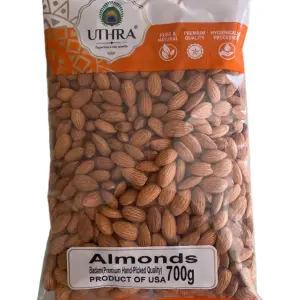
In a small separate pan, heat 1 tablespoon of ghee. Add 2 tablespoons of cashew nuts, halved or broken (Fudco Cashew Nuts Jumbo 700g), 1 tablespoon of sliced almonds (Uthra Almonds 700g), and 1 tablespoon of raisins (Fudco Green Raisins 700g). Fry for 1–2 minutes on medium heat until the cashews are golden and the raisins puff up. Pour the nuts, raisins, and their ghee directly into the halwa. Stir once. Reserve a few fried nuts for garnishing the top.
Gajar Ka Halwa is served warm — not hot, not cold. Warm is when the ghee is still glistening, the cardamom is still fragrant, and each bite is comforting without burning your tongue. Spoon into small bowls (halwa is rich — small portions are appropriate). Garnish each serving with the reserved fried cashews and almonds, a few slivers of pistachio (Fudco Pistachio Kernels 600g), and 2–3 saffron strands (TFS Premium Spanish Saffron Grade 1 — 1g) laid across the top.
For the ultimate indulgence: top each bowl with a small scoop of vanilla ice cream or a tablespoon of cold rabri (thickened sweetened milk). The contrast between warm halwa and cold ice cream is one of the greatest dessert experiences in Indian cuisine.
Every single ingredient for this recipe is available at picknsave.co.uk with home delivery across London and the UK, or click and collect from our store in Harrow. Here's your shopping list:
*RI = Reference Intake. Values are approximate. Gajar Ka Halwa is a traditional Indian sweet — sugar content is inherent to the dish.